

Skin and Soft Tissue Infections
Objectives:
- Know the common bacteria responsible for the different types of skin and soft tissue infections and the appropriate antibiotic choices that correspond to the infections.
- Be able to stratify mild, moderate, and severe skin and soft tissue infections in order to identify the appropriate work up and treatment options.
- Be able to identify when you need to treat for MRSA.
Articles:
- Pediatrics in Review: Staphylococcus aureus 2018 and Group A Streptococcus 2018
- Stevens DL et al. “Practice Guidelines for the diagnosis and management of skin and soft tissue infections: 2014 update by the Infectious Diseases Society of America”. Clinical Infectious Disease, July 2014.
- Liu et al. "Clinical Practice Guidelines by the Infectious Diseases Society of America for the Treatment of Methicillin-Resistant Staphylococcus aureus Infections in Adults and Children," Clinical Infectious Disease, 2011.
- Specific skin infections to consider from Pediatrics in Review: Human and Animal Bites 2018, Periorbital and Orbital Cellulitis 2010
Additional Resources:
- Check out the CHOP clinical pathway for inpatient management of cellulitis/abscess as well as their ER pathway (with great literature references supporting their algorithm management along the right hand side)
- A guideline from Texas Children's Hospital
- Another guideline from UCSF Pediatric Infectious Diseases Program
- NEJM video on How to perform an Incision and Drainage
Self-Assessment:
1. A 3 year old girl presents to your Emergency Room with fever and left sided facial swelling. According to the patient’s mother, she was well until last night but when she woke up this morning she was febrile to 102 degrees F (38.9 C) and very irritable. Several hours later, her mother noticed an area of redness and swelling on the left side of her face. She called her daughter’s PCP and was told to come to the ED.
In the ED, the patient is febrile to 39 C and irritable. She has some mild tachycardia, but otherwise normal vital signs. On physical exam she has an area of bright red skin from just above her mouth to below her eye on the left side and spreading over her nose to the right. The area appears well demarcated around the edges, is slightly raised, and is warm to the touch (see image below). The remainder of her physical exam is unremarkable. She is up to date on her vaccines. She has been otherwise healthy, but has an older brother who was recently treated for Strep Throat.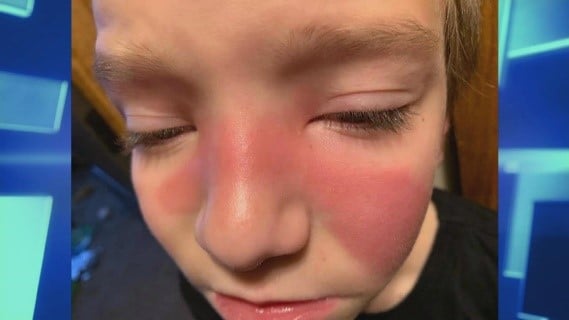
Based on your history and physical exam, what is the best antibiotic to treat this patient with?
- TMP/SMX
- Ceftriaxone
- Cephalexin
- Cefazolin
- Vancomycin
2. A 15 year old male presents to the ED after several days of worsening pain and swelling in his right forearm. His symptoms started several days ago, beginning first as a small area of redness but has since progressed to much larger and more “swollen”. In the emergency room, his vital signs are all normal and is well appearing. He has otherwise been healthy and is up to date on his vaccines. His right arm has an ~3cm raised area on the medial aspect of his proximal forearm. There is a small lesion at the top and the raised area feels fluctuant when palpated.
What is the most important aspect of this patient’s treatment.
- Immediate initiation of IV antibiotic therapy
- Oral antibiotic therapy and then is safe to discharge home
- Incision and drainage
- Ultrasound and xray imaging
3. You are doing your morning rounds on a 7 year old girl admitted for viral gastroenteritis. While you are at her bedside doing her physical exam, you notice a papular rash on her cheeks accompanied by several pustules. You mention this to her mother and ask her if she has noticed this yet? Her mother says that she tends to get eczema on her cheeks and figured that’s all it was. She did mention that it seemed worse today and “weepy”. You take a closer look and notice that there is a yellowish colored discharge crusting over several of the lesions.
How best should you address this rash?
- Prescribe mupirocin BID for 5 days
- Provide education on eczema care and prescribe 1% hydrocortisone ointment to be applied to the region daily until lesions resolve.
- Recommend coating area with petrolatum daily until lesions resolve.
- Do nothing; these lesions seem mild and time will likely heal them.
4. An 11 year old boy comes into the ED with the chief complaint of a fever and ankle wound. His symptoms started yesterday when he started having worsening pain around a cut that was on his ankle. He obtained the cut after accidentally tripping on a lawn chair about 1 week ago. The lesion was healing well, until yesterday when it seemed to get abruptly worse. The fever started this morning, which prompted his parents to take him to the Emergency Room.
He has been otherwise healthy and up to date on his vaccines. He is very active and has been playing outside every day this summer. He went to the beach with his family yesterday where he was climbing on rocks in the water. No one else in his family has similar symptoms.
On physical exam, you see a well appearing boy. He has some mild tachycardia and is febrile to 38 (100.4), but his BP and RR are normal. On his left ankle there is a weepy scab with an area of surrounding erythema and developing bullae. The area is warm to the touch and very tender to palpation. There is no streaking. The remainder of his skin exam is normal.
Of the following, which should you be most concerned about with the above infection.
- Necrotizing fasciitis
- MRSA
- Underlying skin disorder
- Parasitic infection